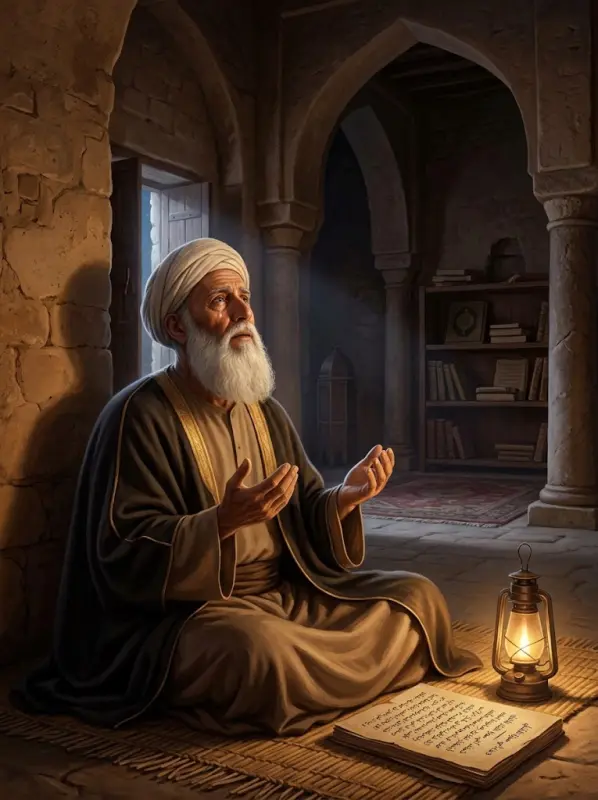
In the eighth century AD, from the historical alleys of Kufa in central Iraq, a man emerged who was not merely a transmitter of sciences, but became a voice for the deepest palpitations of the human soul in its dialogue with the Creator; he is Thabit bin Dinar, famous as Abu Hamza Al-Thumali.
The chronicle of Al-Thumali was not ordinary; rather, it was refined by tragedies and the shocks of loss, as he was afflicted by the killing of three of his sons in the context of confronting the injustice and tyranny in his era.
Despite the bitterness of pain and political turmoil, he did not retreat into himself. Rather, he transformed sorrow into an energy of patience and enlightenment, accompanying four of the senior luminaries of the Prophet's Ahlalabayt (Imam Al-Sajjad, Al-Baqir, Al-Sadiq, and Al-Kazim) (Peace Be Upon Them), until he attained a lofty cognitive status which his contemporaries expressed by calling him "the sage of his time," due to his honesty, his asceticism, and the breadth of his horizon.
The importance of Abu Hamza Al-Thumali transcends the traditional Islamic context to the vaster human space through the immortal spiritual and cognitive text that he transmitted and narrated from Imam Ali bin Al-Hussain Al-Sajjad (Zain al-Abidin) (Peace Be Upon Him), known as the Supplication of Abu Hamza Al-Thumali. This work is not merely a religious ritual, but rather it is a cognitive existential document and confessional literature that educates the human being and refines his behaviour. It resembles in its spiritual and analytical depth the greatest confessions of global literature, where the human being stands stripped of all falsehood and titles, confessing his weakness, his fragility, and his fear of nothingness and death, in exchange for aspiring towards an absolute divine mercy that transcends all boundaries, and is capable of solving his problems and fulfilling his needs in the immediate world and the Hereafter.
The reader, whether a Muslim or a researcher in philosophy and religions, finds within it a human language that touches the feelings of anxiety and hope which all human beings share.
Al-Thumali died in the year 150 AH (circa 767 AD), leaving for the generations a cross-cultural message: that true faith is not an isolation from reality, but rather it is the capacity of the spirit to ascend above personal wounds, and to formulate a language of hope that embraces the weak and instils tranquillity in lost hearts.