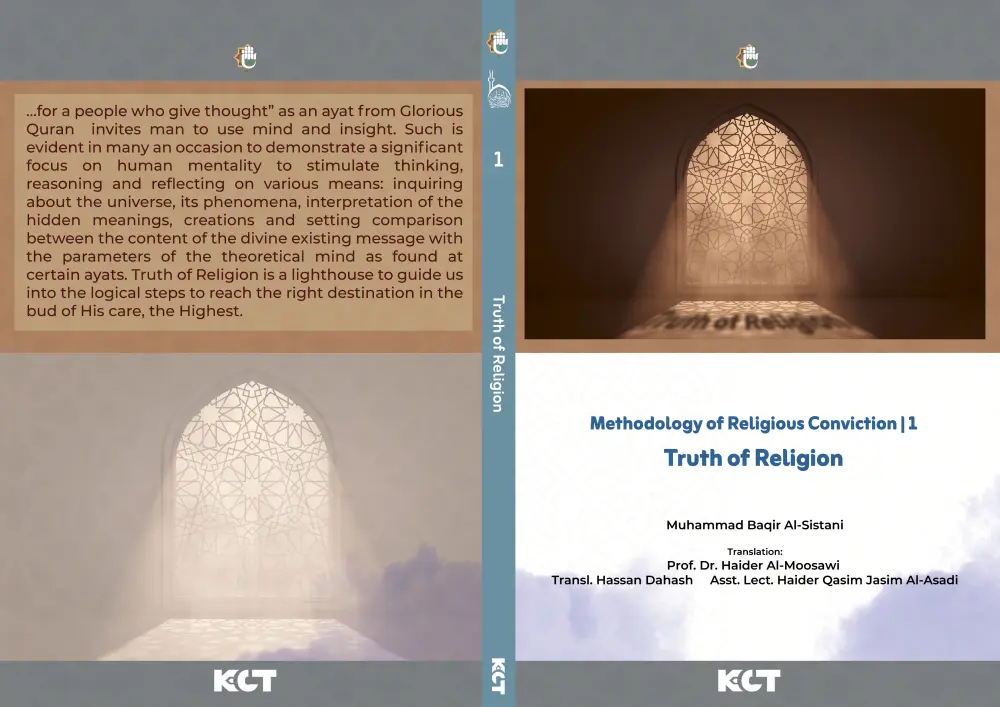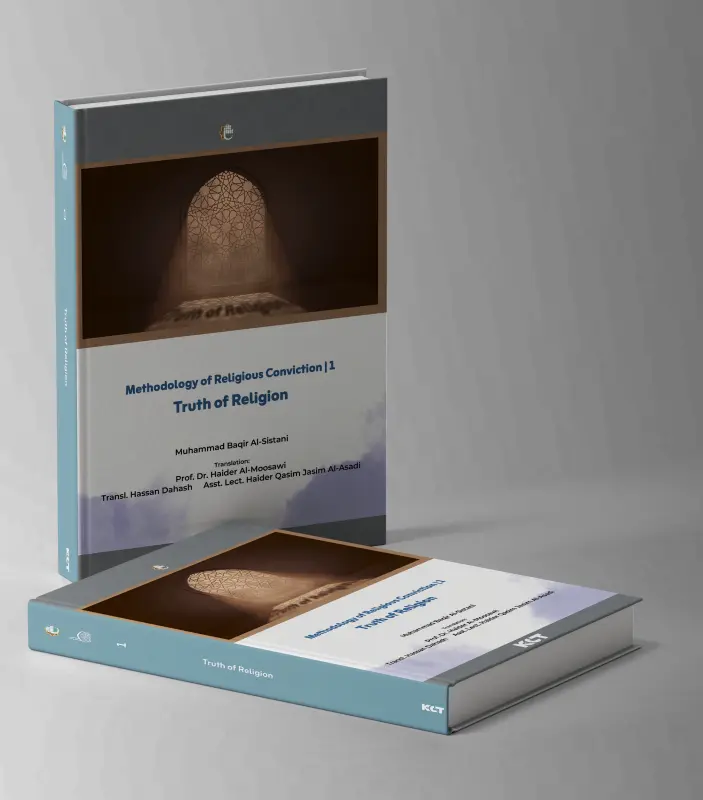
Department of Cultural and Intellectual Affairs at
Holy Al-Abbas Shrine, through Al-Kafeel Centre for Translation (KCT), has
officially released the first English edition of Truth of Religion,
authored by the prominent scholar Sayyid Muhammad Baqir Al-Sistani.
The 157-page volume marks the inaugural installment
of the Methodology of Religious Conviction series (ISBN:
978-9922-26-008-2). Rendered into English by a translation team comprising
Prof. Dr. Haider Ghazi Jassim Al-Moosawi, Hassan Dahash, and Asst. Lect. Haider
Qasim Jasim Al-Asadi, the project was conducted under the general supervision
of Sayyid Laith Al-Musawi and Sayyid Aqeel Al-Yasiri. The work is cataloged and
officially registered with the Iraq National Library and Archives in Baghdad.
Originally delivered as specialized scholarly
lectures, the work has been systematically restructured to provide an academic
and philosophical discourse accessible to university students, researchers, and
global readers. The study addresses modern ideological skepticism, presenting a
coherent alternative to atheistic, deistic, and agnostic perspectives by
drawing directly from primary sources—namely the Glorious Quran and Nahjul
Balagha.
Rather than relying purely on apologetics, the author
employs a rigorous tripartite epistemological and legislative methodology,
balancing decisive rational deduction with devotional submission in allegorical
spheres. The study investigates the core reality of religion across four
central dimensions:
- Epistemological Vision:
Affirms that while the human intellect independently discovers fundamental
axioms, divine revelation and the missions of the Prophets—culminating in
Prophet Muhammad, Peace Be Upon Him and His Pure Progeny—serve as
indispensable cognitive guides to deliver humanity from superstition and
unveil transcendental realities.
- Cosmological Vision:
Argues for a single, non-material, omnipotent, and omniscient Creator
whose purposeful origination of the universe places humanity along an
intentional path toward the Hereafter.
- Anthropological Vision:
Depicts the human being as endowed with innate disposition (Fitra),
moral conscience, and free will, guided by divine providence and spiritual
guardianship rather than deterministic materialism.
- Legislative Vision:
Addresses contemporary inquiries regarding Islamic jurisprudence and Fiqh,
demonstrating that legislation is firmly rooted in inherent justice,
universal rights, and virtue, while distinguishing between permanent
principles and context-sensitive applications.
Truth of Religion is now available to academic institutions, university libraries, and international scholars specializing in Islamic theology and contemporary religious philosophy.